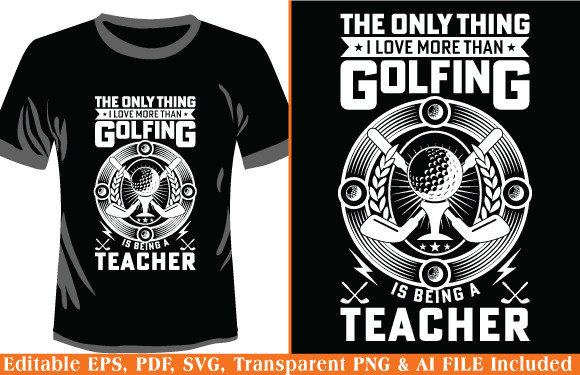
Golfing Teacher Design: An Embroidery Review
As a professional embroidery digitizer and product reviewer, I approach every new graphic with a specific question: will this actually stitch out cleanly on fabric? When evaluating the Golfing T-shirt Design Teacher, my focus shifts immediately from the screen to the hoop. This design features the sentiment "The only thing I love more than Golfing is being a Teacher," presented in a typography vector style. While it is marketed as a vector t-shirt graphic, its potential for machine embroidery projects is significant, provided you understand how typographic designs translate into thread.
My first impression of this artwork is that it carries a warm, relatable personality. It strikes a balance between hobbyist passion and professional pride. For an Etsy seller or small shop owner targeting educators who golf, this niche crossover is gold. However, because it is primarily a typography-based layout, the success of your finished product depends entirely on font legibility and stitch density management. Unlike complex illustrations where minor errors hide in the details, text-based embroidery demands precision. If the letters are too thin or the spacing is off, the message gets lost in the fabric texture.
Real-World Application: The Teacher Appreciation Tote
To truly test the viability of this design, I mentally mapped it onto a recent client request: a custom canvas tote bag for a retiring physics teacher who spent his weekends on the course. This scenario highlights both the strengths and challenges of the Golfing T-shirt Design Teacher. A tote bag offers a stable, flat surface ideal for text, but canvas has a distinct weave that can swallow fine details.
In this real-life application, the design serves as a personalized gift that feels bespoke rather than generic. Because the phrase is long, I had to consider the vertical space. On a sweatshirt or apron, you have ample room to stack the text lines comfortably. On a smaller item like a cap or baby bib, this specific design would likely fail without heavy modification. The length of the sentence structure makes it best suited for medium-to-large hoop sizes on flat garments. For my teacher’s tote, the design worked beautifully as a center chest or back panel piece, creating a high-value handmade product that justified a premium price point due to its personalization factor.
Translating Vector Graphics to Stitch Files
It is crucial to remember that this product is listed under Graphics and T-Shirt Designs as a vector file. Vectors are mathematical paths, not stitches. Before you can run this through your embroidery machine, it must be properly digitized. Do not rely on auto-digitizing software for a text-heavy design like this. Auto-digitizers often struggle with the variable widths of typography, leading to uneven satin stitches or jagged fill areas.
When converting this vector art into a digital embroidery file, pay close attention to the font weight. If the original graphic uses a distressed or vintage font, you may need to simplify the edges for stitching. Distressed textures look great in print but can cause thread breaks and registration issues in embroidery. I recommend adapting the lettering to a clean satin stitch or a dense fill stitch depending on the size. For larger applications on sweatshirts, a fill stitch inside the letters provides stability and coverage. For smaller left-chest placements on polo shirts, a satin stitch column is preferable, provided the letters are wide enough to support it without puckering.
Fabric Considerations and Stabilizer Strategy
The performance of the Golfing T-shirt Design Teacher varies drastically based on your substrate. Typography is unforgiving on stretchy or textured fabrics. Here is how I evaluate placement safety:
- Cotton T-Shirts and Polos: Ideal candidates. Use a cut-away stabilizer to prevent the fabric from stretching during the stitch-out. The design should remain crisp after washing.
- Terry Cloth Towels and Aprons: The loops of the fabric can obscure thin lettering. You must use a water-soluble topping to keep the stitches visible on top of the pile. Without topping, this design will disappear into the towel.
- Stretchy Knits and Performance Wear: Proceed with caution. Golf apparel is often made of slippery, four-way stretch polyester. This design requires a fusible no-show mesh stabilizer and potentially a temporary spray adhesive to lock the fabric in the hoop. Test the stitch density first; if it is too high, it will create a bulletproof patch that distorts the garment.
- Caps and Curved Surfaces: Unless the design is specifically reformatted for a curved cap frame, avoid using the full quote. The horizontal span of the text will distort on a curved surface. Extract just the key phrase or use a simplified icon version for headwear.
Commercial Viability for Makers and Sellers
For creative entrepreneurs and craft business owners, this design offers strong commercial potential, but only if executed professionally. Customers trust sellers who deliver durable, readable embroidery. A shirt where the teacher/golfer sentiment is partially illegible due to poor digitizing reflects poorly on your brand consistency.
When listing this as part of your Etsy shop inventory or boutique collection, use printable mockups to verify the visual balance before stitching. However, always follow up with a physical sample. Check the thread colors against various fabric backgrounds. White text on a navy shirt reads differently than navy text on a white shirt. Ensure there is sufficient contrast so the message is accessible and visually striking. This level of quality control separates professional apparel decorators from hobbyists and increases buyer engagement.
Furthermore, verify your licensing. Since this is sold as a vector graphic, confirm whether you have the rights to sell finished embroidered products versus selling the digital embroidery file itself. Most vector licenses cover physical end-products but prohibit reselling the digitized file. Clarifying this protects your business and respects the original artist's intellectual property.
Practical Designer Notes for Success
Before committing the Golfing T-shirt Design Teacher to a final project, run through this practical checklist derived from years of commercial embroidery experience:
- Test on Scrap Fabric: Never stitch directly onto a customer’s garment without a test run. Use a similar fabric weight and weave to check for registration issues.
- Audit Small Details: If the design includes small decorative elements like golf balls or tees alongside the text, ensure they are large enough to stitch clearly. Anything under 4mm in height risks becoming a thread nest.
- Check Stitch Density: Pull apart the fabric slightly after the test stitch-out. If you see gaps between stitches, increase density. If the fabric is stiff or warping, decrease density or change the stitch type.
- Evaluate Washability: Teachers wash their clothes frequently. Ensure your thread choice (polyester vs. rayon) matches the care requirements of the garment. Polyester is generally more colorfast for everyday school wear.
- Mockup in Black and White: Remove color to judge the value contrast. If the design looks muddy in grayscale, it will lack pop in thread.
Ultimately, the Golfing T-shirt Design Teacher is a versatile asset for the right maker. It speaks to a specific, passionate demographic that loves to showcase their dual identities. By treating this vector graphic with the technical respect required for embroidery, you transform a simple digital download into a cherished, tangible keepsake. Whether you are creating holiday embroidery gifts for staff, outfitting a golf team of educators, or stocking your shop with niche custom apparel, success lies in the details of execution. Respect the fabric, refine the digitizing, and the result will be a product that both teachers and golfers are proud to wear.